Matrix estimator
The matrix estimator is used to iteratively adjust demand matrices until assigned traffic volumes converge toward the observed counts.
Parameters
Parameters are defined in the parameters key/value sets and are scenario specific.
| Parameter | Description | Default value |
|---|---|---|
| scenarioType | Determines which factor from the demand_generation_factors collection is used, either Minimum 0, Average 1 or Maximum 2 |
1 |
| purposes | Determines which purposes to calculate. When left empty, all purposes from the demand_purposes collection are used. To use a subset of purposes, enter the OBJECT_ID from the demand_purposes collection as a list. |
Data requirements
The estimator requires the same input data as a standard assignment, supplemented by the following collections and attributes.
Collection traf_counts
| Name | Key | Type |
|---|---|---|
| COUNT | 161 | double |
| WEIGHT | 185 | double |
Collection traf_count_screenlines
| Name | Key | Type |
|---|---|---|
| IS_LEFT | 176 | bool |
| ROAD | 162 | guid |
| TRAF_COUNT | 170 | guid |
Methodology
The Matrix Estimator uses traffic counts in a feedback loop with traffic assignment. During each iteration, the estimator modifies the demand matrices used by the assignment so that assigned link intensities progressively align with the observed traffic counts. The model uses two primary objective types:
- Traffic count, the observed number of vehicles during the simulation period used by the assignment.
- Screenline, a network link representing one side or direction of a road, together with its dimension and associated traffic count. A traffic count may be associated with multiple screenlines; in that case, the sum of the assigned volumes across those screenlines should equal the traffic count.
The estimation process consists of:
- Run the full assignment: A complete traffic assignment is performed using the current demand matrices.
- Build compact screenline matrices: The assignment is repeated while compact matrices are generated for each screenline.
- Estimate matrix adjustments: The estimator compares assigned volumes with observed counts and shifts trips within the matrices.
- Reassign and iterate: The adjusted matrices are used for a new assignment and estimation cycle.
- Apply stopping criteria: Iteration continues until the user-defined stopping parameters are met.
Matrix output field
The trip adjustments calculated by the estimator are written to the DeltaTripsMatrixEstimator column in the matrix.
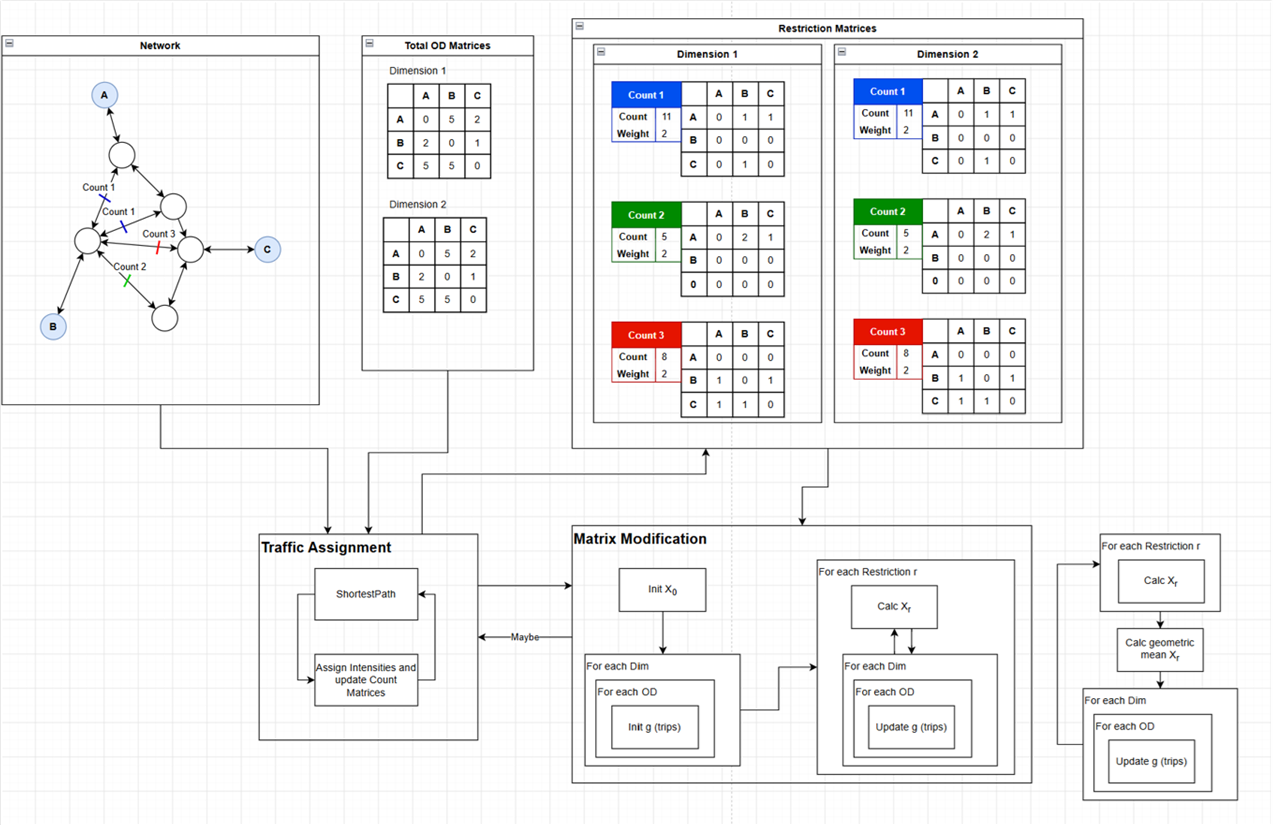 Matrix estimator diagram